
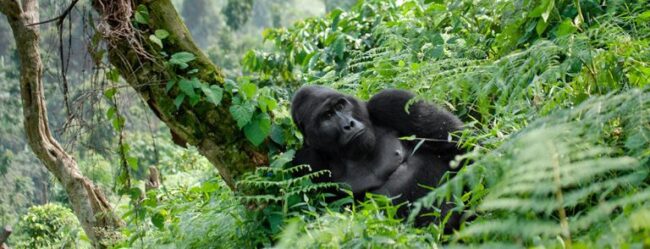
Bwindi Impenetrable National Park is ranked number one for safaris in Uganda. Bwindi officially became a national park in 1991, and around 1994, it was designated as a UNESCO World Heritage Site thanks to its biodiversity. Bwindi Impenetrable National Park has its boundaries extend across the 3 main districts in the Kigezi region, including Kabale, Kanungu, and Kisoro. It is among the few parks in Africa that are located along the Albertine Rift Valley area and sits in the altitude range of 1160 to 2607m.
Wildlife in Bwindi
Bwindi remains one of the naturally endowed destinations and accounts for about 120 species of mammals, which include 11 primate species. The diverse primates to find in the lush Bwindi Impenetrable Forest include olive baboons, l’hoest monkeys, over 500 mountain gorillas, colobus monkeys, red-tailed monkeys, Demidoff’s galagos, and pottos.
Bwindi also supports other mammal species including buffaloes, bush pigs, African forest elephants, black-fronted duikers, yellow-backed duikers, and giant forest hogs. This park also shelters a range of reptile species, over 220 butterfly species, diverse floral species, and more.
Bird species
Bwindi alone is home to an estimated bird population of about 360, which includes 23 endemic species. The checklist of birds that reside in the scenic Bwindi Impenetrable National Park includes the blue-headed sunbirds, African emerald cuckoos, cream-banded swallowtail, African green broadbill, common bulbul, red-headed bluebill, Shelley’s crimson, stripe-breasted tit, and mountain masked apalis. Bwindi also holds birds such as the regal sunbirds, Doherty’s bushrike, black-billed wood-doves, handsome francolins, montane oriole, Rwenzori nightjars, and Namaqua doves.
Additional species of birds in Bwindi include yellow-eyed black fly-catchers, Rwenzori batis, and Grauer’s warblers. During the birding expedition, expect to start your day in the bamboo zone, Buhoma fall trail, and Mubwindi swamp.
Activities to expect to do in and around Bwindi
Gorilla trekking
Gorilla trekking is the must-do safari activity you should expect on a tour in Bwindi Impenetrable National Park. The day trek with gorillas in Bwindi starts from the 4 main trailheads/sectors, including Buhoma, Nkuringo, Ruhija, & Rushaga. About 25 families of gorillas have so far been fully habituated and they have been dedicated for tourism purposes.
A normal gorilla trekking session can extend for about 2-6 hours. There will be a chance to observe gorillas and take their pictures for one hour –this is mandatory for all visitors once they have come across gorillas. Gorilla treks in Bwindi are organized with a day session, often starting with a briefing where tourists get insights into the safety measures or rules/regulations.ons.
The park official who conducts the briefing ends the session with the allocation of gorilla groups and ranger guides. The entire process of planning the gorilla trekking safari to Bwindi starts with securing a valid Uganda gorilla permit, which is booked at USD 800 per person.
Gorilla habituation
Bwindi is where you get a chance to experience the best of gorilla habituation. It is the only destination that you can consider exploring on a gorilla habituation safari in Uganda/Africa. While in Bwindi, the focus should be on the Rushaga region in the southern part of the park. Gorilla habituation is the initial stage of making gorillas get used to human presence. This is usually conducted before the gorilla families are opened for the normal gorilla trekking sessions. Visitors with plans to join the gorilla habituation session should begin by booking a valid permit at USD 1500 per person.
Birding tours
Bwindi Impenetrable National Park is one of the best places one can visit to explore the diversity of birds, especially forest and Albertine rift species. Expect to explore a range of amazing bird species, including Kivu ground thrush, cream-banded swallowtail, yellow-eyed flycatchers, and dusky crimson wings. The most rewarding spots to explore on a birding tour in Bwindi include Mubwindi swamp/wetland, Bamboo zones, Buhoma waterfall trail, Munyaga River trail, etc.
Nature walks or forest walks.
Nature/forest walks are excellent for all visitors who like to embark on a journey to explore the deeper part of Bwindi Impenetrable Forest. Guided nature walks in Bwindi introduce you to locations with abundant bird species and interesting mammals hardly spotted on gorilla trekking session.
The popular trails to explore on a guided nature walk in Bwindi include the Rushura trail, Bamboo trail, Munyanga River, Rusizi, Muzubijiro loop trail, Ivy River, and Habinyanja hiking trail.
Biking (cycling) tours
Cycling or biking tours in Bwindi offer an incredible option for tourists to experience places near the park. Expect to traverse the pathways close to the lush Bwindi Impenetrable Forest while viewing some amazing species like monkeys. You can also observe locals as they conduct their daily activities.
The Batwa cultural tour
Visit not only to see gorillas but also to interact with the Batwa pygmies –the historical occupants of the Bwindi Forest. The Batwa today reside adjacent to Bwindi and Mgahinga after they were displaced in 1991 when the two protected areas were declared National Parks.
Packing for Bwindi National Park safaris
Ultimate care must be taken as you plan for your safari to Bwindi. The general packing list for Bwindi safaris includes insect repellents, a rain jacket, waterproof hiking boots, gardening gloves, long-sleeved shirts, and a daypack. A camera, long pants, water, a pair of socks, energy-giving snacks, and valid gorilla permits in case of those who plan to go to track gorillas.
When to visit Bwindi
A tour can be planned at any time for you to explore Bwindi. The park experiences favorable climatic conditions, but the dry season is the best for you to smoothly wind through the park’s forest while searching for mountain gorillas, plus other activities. As you plan a safari to Bwindi, the dry months to target are June, July, August, September, December, January, and February. Anytime around these months, you can have a successful gorilla trekking experience with fewer inconveniences from the rain.
The wet or rainy months are often preferred, especially for nature enthusiasts whose interest is in birding. On the travel calendar, you can opt to embark on a birding tour around the low/rainy season from March to May or around October & November.
Where to Stay –Different Camps and Lodges
Top places to consider for night stays in and around Bwindi include budget, midrange, and luxury. They include Chameleon Hill Lodge, Volcanoes Bwindi Lodge, Gorilla Heights Lodge, Clouds Mountain Gorilla Lodge, Buhoma Lodge, and Four Gorillas Lodge. The standard/midrange accommodation options include Ride 4 a Woman, Eco Marvel Gorilla Resort, Bakiga Lodge, Engagi Lodge, Gorilla Mist Camp, and Buhoma Community Camp.
Getting to Bwindi
Bwindi Impenetrable National Park can be reached in two ways: by road or by air. If you consider traveling by road, expect to take at least 8-9 hours, but this may vary depending on the driver’s speed or the nature of the road. This is particularly for tourists who plan to depart from Entebbe or Kampala, and if you are in Kigali, you can drive for about 4-5 hours. From Kigali, your journey includes border crossing through Katuna or Chanika and you continue safely up to Bwindi.
Using air transportation, visitors can utilize the domestic flight service. These are available for tourists who need to make their journeys shorter and not spend long hours driving.iving. The flights depart from Entebbe International Airport or Kajjansi Airfield to Kihihi Airstrip or Kisoro Airport. Upon landing at either Kisoro or Kihihi, you can be transferred to the lodge near or in Bwindi National Park.