
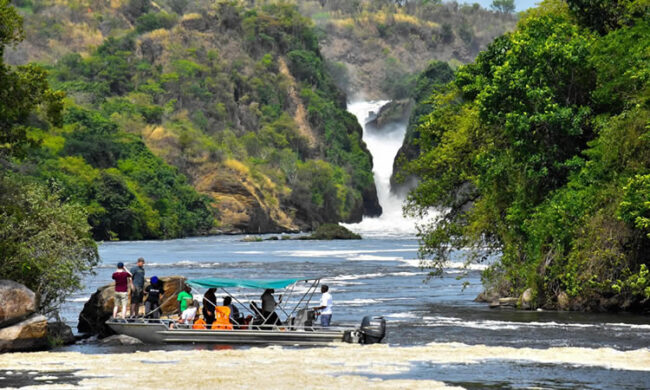
Murchison Falls National Park is not only the largest park in Uganda, but also one of the oldest conservation areas. Created in 1926 as a Game Reserve, and later upgraded into a National Park in 1952. Today, Murchison Falls NP features at the top of the list of destinations to be explored on a Uganda safari. Murchison is also among the few parks that are located on the edge of the Albertine rift valley area.
Murchison expands up to 3840 sq. km with a great portion of it comprising largely of the savanna plains, rainforest, Borassus palm trees, riverine woodland, and acacia vegetation, etc. Within the vast Murchison Falls Conservation Area, there exist about 4 protected areas with Murchison Falls NP inclusive. The rest include Karuma Wildlife Reserve, Budongo Forest, & Bugungu Reserve. The park derives its name from the powerful Murchison waterfall which separates it into 2 sections –the greater Northern and Southern sectors. Murchison waterfalls is most popular for its powerful roar and can be witnessed as it plunges 45 m, creating what many describe as the devil’s cauldron below. After, it flows towards Lake Albert.
At the top, visitors can witness how Murchison Falls forces itself to enter a narrow rock of 8 meters. As it flows towards the Albertine Nile, it forms a charming appearance and do not forget to observe the natural rainbow that is formed as a result.
Where is Murchison Falls Game NP?
Murchison Falls National Park lies within the 4 main districts in the Northwestern circuit of Uganda and includes Buliisa, Nwoya, Masindi, and Kiryandongo. This game park stretches with its boundaries encompassing Lake Albert.
Unique Attractions to Explore in Murchison Falls NP
Wildlife
It is without doubt that Murchison Falls National Park is one of the endowed parks with a total of about 76 species of mammals, several amphibians, reptiles, and birdlife. The diverse wildlife in this park reside in the varied habitats in the Northern and Southern regions.
The main wildlife to expect to find here includes the African elephants, lions, the Rothschild giraffes, warthogs, Uganda Kobs, Jackson’s hartebeest, waterbucks, hippos, and leopards. The park also protects other animals, including the Nile crocodiles, the grey duikers, oribis, buffaloes, and, not to forget, the primates. The key primates that survive in the lush rainforest in Murchison (Kaniyo-Pabidi and Budongo Forest) include blue monkeys, colobus monkeys, red-tailed monkeys, & baboons.
The birds
Estimated population of about 451 species of birds have been recorded in Murchison alone, making it a great birding destination in Uganda. The birds of visitor interest include malachite kingfishers, eastern grey plantain eaters, black-headed lapwings, blue-headed coucals, red-throated bee-eaters, elusive shoebill storks, and giant herons. Other bird species include African darters, long-tailed nightjars, African jacanas, palm-nut vultures, African qualifinch, piapiac, black-billed barbets, long-toed plovers, Abyssinian ground hornbills, swamp flycatchers, blue-headed coucals, osprey, and marabou storks.
Murchison Falls National Park also has birds such as the sandpipers, pratincole, standard-winged nightjars, secretary birds, Senegal thick-knee, and more.
Around the Budongo region, expect to interact with birds such as chestnut-capped flycatchers, yellow-footed flycatchers, brown twin-spot, Puvel’s illadopsis, olive-breasted greenbul, and Cassin’s hawk-eagles. Budongo Forest also shelters birds, including chocolate-backed kingfishers, grey-headed sunbirds, little green sunbird, black-eared ground thrush, Cassin’s spine tail, and others.
Other ideal birding spots you should expect to cover a great bird population include Kaniyo-Pabidi forest, Lake Albert delta, Paraa & Red Chilli area. Several of the bird species that survive in the scenic Murchison can be explored during the guided game drive, nature walk, and boat or launch cruise experience.
Things to do in & around Murchison Falls NP
A tour to Murchison Falls NP allows you to indulge in a number of activities that include game drives, birding/bird watching, nature walks, boat cruises, and chimpanzee tracking. Below are detailed safari activities to engage in on your next visit to Murchison Falls National Park.
Game drives
When it comes to game drive sessions, Murchison never disappoints. Visitors have the opportunity to be part of the rewarding morning or afternoon game drive experience. A guided game drive session through the savanna plains of Murchison Falls National Park offers you a chance to find your favorite wildlife and birdlife. Among the interesting species of animals to explore here are the buffalo, giraffes, oribis, Kobs, elephants, lions, leopards, and more. Approximately 2-3 hours are adequate to get you the best of the Murchison Falls game drive experience. In the morning, it is advisable to set off as early as you can to catch up with the park’s sun risers.
Launch cruise –scheduled/private
Expect to explore the Victoria Nile River using the boat. This can be in the morning or afternoon during the private boat tour or scheduled session. Each session runs for about 2-3 hours, and the beauty about it is that you have the opportunity to interact with many aquatic species, including birds, crocodiles, and hippos.
Hikes to the top of the falls –with an expert
The hike to the top of the falls remains one of the amazing experiences awaiting you on a safari. This is expected to take about 45 minutes via the slightly hilly part of the park to reach the top.
Chimpanzee tracking
Get a chance to visit chimpanzees that survive in the lush Budongo Forest, and witness how close these primates are to us, humans. The estimated population of about 800 chimpanzees calls Budongo home, and overall, these apes are believed to share about 98.7% of their genes with humans. During the chimpanzee trek, expect to learn more about these primates’ unique behaviors and take pictures.
Birding tours
Embark on the enriching birding tour, with a great deal to explore and a variety of birds. The different birds to expect to find here range from woodland, riverine, aquatic, to forest dwellers. The popular and unique species to identify include the goliath herons, open-billed storks, black-bellied bustards, and blue-headed coucals.
Sport fishing
Sport fishing is an exceptional adventure that anglers shouldn’t miss on a visit to Murchison. The participants converge around the base of the falls or Karuma waterfalls to conduct the sport fishing excursion.
Whitewater rafting adventure
Murchison Falls National Park authorities recently introduced a white water rafting experience that you can take part in. This offers you a unique opportunity to explore the scenic Nile River.
Community tourism/Visit.
Visitors on a wildlife safari to Murchison also have a chance to spice up their holiday with community experiences. During the cultural/community visits, expect to enjoy the real-life experiences from the communities living adjacent to Murchison Falls National Park, like the Bomu Woman Group.
When to visit Murchison Falls Game NP
Murchison Falls National Park welcomes tourists all year round due to its ideal weather conditions often experienced in the two seasons. The dry and wet seasons play a pivotal role in guiding visitors on the ideal time to go explore Murchison Falls NP. The dry season/months offer the best conditions for wildlife tours and it is recorded from June to September, and December to February. The low season or rainy months are often preferred by tourists interested in cutting costs, and it occurs from March to May or (October to November)
Where to stay (camps/lodges/budget-luxury)
Three categories of lodges and camps are available in Murchison: budget, midrange, and luxury. Top places to stay include Murchison River Lodge, Paraa Safari Lodge, Chobe Safari Lodge, Bwana Tembo Lodge, Parkside Safari Lodge, Pakuba Safari Lodge, and Red Chili Lodge.
How to reach Murchison NP
By road, you can be picked up from Entebbe or Kampala and drive via Luweero and reach the park via the Southern entry gate (Kichumbanyobo). Driving time can be 6-7 hours and comes with an en route stopover at the Equator crossing. If you are accessing the park from the northern part, then use the Tangi, Wankwar, & Chobe gates. Using flights, depart from the Entebbe International Airport or Kajjansi Airfield for you to land at the Chobe airfield, Paraa/Bugungu Airfield.